| San Francisco Bay Area designer, Stella Carakasi, features her women's collection at stellacarakasi.com and at her flagship store in Berkeley, California. Stella explains, "My clothes are designed for women who value quality and practicality and are not afraid to be unique and a bit eclectic. They are confident, bohemian at times, and they like to make personal statements with their style. My clothes are not about age or body type, but rather about lifestyle." |
| Read more about Stella Carakasi, her journey, her lifestyle, and her philosophy on life/work balance. |
Embracing the Light with Stella Carakasi
Posted by Stella Carakasi on
4 Easy Steps to Transition Your Wardrobe
Posted by Stella Carakasi on
Transitioning your clothes from one season to the next doesn’t have to be a chore. … Continue reading 4 Easy Steps to Transition Your Wardrobe From Summer to Fall
Read more →
Stella Carakasi Flagship Store Is Turning One!
Posted by Aamir Khan on
Stella wanted to create a beautifully curated boutique that was more than just a showroom, but a creative space to collaborate with other artists, local designers and to connect with her customers.
Read more →
Sustainable Shopping: 5 Tips For Reducing Your Fashion Footprint
Posted by Stella Carakasi on
Here at Stella Carakasi we are constantly looking for ways to infuse sustainability into our clothing and the way we do business because we believe that even the smallest of choices can make a big impact. With this in mind, we thought we would share some ways to incorporate sustainability into your own life, especially when shopping for clothes!
5 Tips For Reducing Your Fashion Foot Print:
1. Shop online
2. Prioritize natural fabrics
Synthetic materials like polyester, nylon, and acrylic can take up to 1,000 years to decompose—which means that all of the polyester that has ever been made still exists. Those materials account for a large chunk of the clothing that’s currently sitting in landfills. Choosing all-natural fabrics is one way to work toward a more sustainable wardrobe—try silk, organic cotton, wool, hemp, cashmere, alpaca, and Tencel, which are more luxurious, breathable and feel great on your body. (Stella even uses recycled paper in some of her sweaters!)

3. Invest in high-quality products, not quantity
Choose clothes that are made with the best craftsmanship, the finest materials, and timeless classic design. Durability is a key component in the environmental impact of a garment because its carbon footprint decreases every year that you own it.
4. Consider the number of uses
Ask yourself: “Can I wear this to work and to brunch?” and “Can I wear this in multiple seasons, or year-round?”. When you choose clothes that you can picture in different places and climates you’ll keep them longer and get more use.

5. Capsule your wardrobe
A clothing capsule is an extremely edited collection of versatile pieces that can be endlessly mixed and matched, so that you get maximum use out of minimal possessions. The goal is to gain clarity of your personal style and only purchase pieces that make you feel like your best self. With a thoughtfully curated wardrobe, you can easily put together a great outfit and you’ll no longer find yourself making hasty purchases because you have nothing to wear. (You can contact a stylist at Stella Carakasi to get styling advice and help curating your own capsule.)
As part of our effort to support sustainable fashion we are excited to announce that throughout the month of June and for the first half of July, our flagship store in Berkeley, California will be hosting an in-store pop-up with Vincetta Studio, a collection of season-less pieces with intentionally minimalist design. To kick off this exciting collaboration, we are co-hosting a Sip & Shop event Monday, June 11, 2018, from 4 to 6 pm. Click here to RSVP!
Make Every Day Earth Day
Posted by Stella Carakasi on
We use eco-friendly fabrics whenever possible because we believe that every choice can make a difference. In celebration of Earth Day we want to shine a spotlight on one of Stella Carakasi’s favorite fibers to give our customers a deeper understanding of the impact their purchases can make on the environment. As an early eco-adapter, Stella has been using Tencel in her designs since 1996; not just for the incredible softness and drape but because this innovative fiber speaks to her commitment to manufacture clothing in a responsible way.
What Is Tencel?
Tencel is a sustainable fabric, regenerated from wood cellulose. It is obtained from eucalyptus trees that are grown on farms—no old growth forests, genetic manipulation, irrigation or pesticides are used. These forests and the pulp produced for Tencel have earned Forest Stewardship Council (FSC) certification that the products come from socially and environmentally responsible forests. The European Programme for the Endorsement of Forest Certification has also endorsed Tencel’s farming practices as sustainable. Tencel eliminates the negative environmental impacts of traditional fiber processing, using new sustainable technologies.

Tencel has some distinct advantages over traditional fibers in terms of chemical processing, which can often be extensive and toxic. For example, Rayon manufacturing generates highly polluting air and water emissions, uses catalytic agents containing cobalt or manganese and creates a strong, unpleasant odor. On the other hand, the chemicals used to produce Tencel fibers are nontoxic.
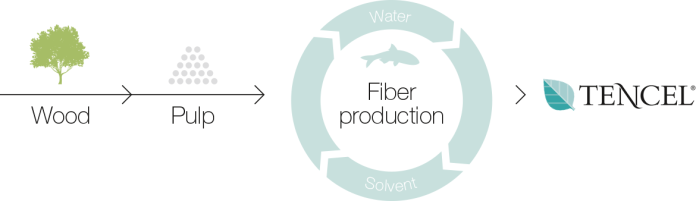
The cellulose or ground pulp used for Tencel is treated in what is known as a closed loop process in which these solvents are recycled with a recovery rate of 99.5%. The tiny amount of remaining emissions is decomposed in biological purification plants. Because of the nature of the material, the processing never requires bleach. This overall method of manufacturing fabric was awarded the “European Award for the Environment” by the European Union.